
2026 behavioral study
The state of AI visibility for travel in 2026
A week-long, screen-by-screen look at how travelers use AI to research, build trust, and book
Why we watched
Surveys tell you what people say. We wanted what they do.
The travel industry has no shortage of survey data on AI. Surveys tell you what people say they do, which is rarely the same as what they do. We wanted to see travelers in action, actually booking trips.
Propellic partnered with Touchstone Research, a highly credentialed, tech-driven full-service market research and consumer insights agency, to run the study. Over a week, US travelers planned real trips with AI while we recorded their screens and listened to them think out loud. Five activities covered the journey end to end: choosing a destination, researching hotels, building a multi-day itinerary, finding day tours, and the handoff to booking. Participants used their own tools, mostly ChatGPT, Gemini and Google AI Mode. Nobody was asked their opinion of AI. They were asked to plan a trip.

"They hand over discovery, comparison and shortlisting without hesitation, and they rate the results highly. Then they reached the booking step and took it back themselves." The state of AI visibility for travel in 2026

Section 02
Eight findings, four stages of the trip
Discover

Travelers stick to one AI
Travelers settle on one AI tool and rarely look at a second.
What we saw
Participants planned with whatever they already used, and the spread was narrow. ChatGPT took more of the total than Gemini and Google AI Mode together. The more interesting behavior is how few people used two. Most travelers stayed inside one tool for the full week, and every traveler who used more than one had ChatGPT in the mix.
The split lines up with the wider market. Statcounter tracks US AI chatbot share at population scale and puts ChatGPT well ahead of every other assistant, with the rest clustered a long way behind. The detail public trackers miss is Google. Gemini and Google AI Mode together took 42% of tool use, and AI Mode is invisible from the outside because as traffic it's indistinguishable from ordinary Google. That's one reason organic search can still look steady in a dashboard while the behavior behind it has moved.
What to do
- 1Test the three that matter. Put your brand and your category through ChatGPT, Gemini and Google AI Mode and read what each returns.
- 2Ask the way your market asks. The answer built for one origin market is not the answer another one gets.
- 3Index monthly, and have someone own this process. There is software for this, like Peec.ai, Profound, etc.

Big brands read as ads
Travelers are learning to spot and discount OTA links as ads.
What we saw
A heuristic is forming: a large recognizable travel brand in an AI answer reads as an ad, so discount it, even when the placement is entirely organic. One participant left a major aggregator out of his count of real options on that assumption alone. A named local operator with a phone number reads as the AI's genuine recommendation, and where only aggregator links appeared, travelers called it a shortcoming. It's as if they assume the AI has already done the OTA's job.
They still wanted both: the aggregator for ratings and a cheaper option to compare against, the operator to actually book with.
What to do
- 1Lean into the "local" and "homegrown" representation of your brand.
- 2Name specific people: the founders, the owners, the guides.
- 3Keep your business details identical on every surface AI reads. The direct mention comes with a phone number attached.

Structure earns trust
Trust is built by structure, not by content.
What we saw
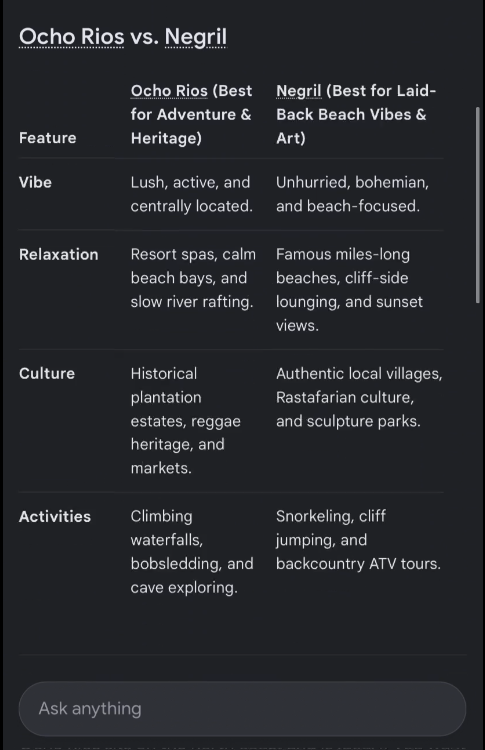
Trust came from structure and somewhere to fact-check it. Asked why they trusted a recommendation, participants pointed to comparison tables, ranked lists with stated reasoning, source links, and clarifying follow-up questions, far more often than to the substance of the recommendation itself.
70% trusted AI recommendations more than traditional search results and 25% trusted them about the same, which leaves 5% who trusted them less. Sessions were short too: two to four prompt entries, some stopping after one, and for some the AI's first list was the final shortlist.
What to do
- 1Say why, not just what. AI reproduces your reasoning, and travelers trust the why more than the recommendation.
- 2Answer the follow-up questions people usually ask, on the page. Travelers pack everything into one loaded prompt, so the first response has to cover it.
Plan

Multi day was self planned
Operators of multi-day tours must work extra hard to be referenced.
What we saw
No participant considered a guided tour package. This was not AI beating packages in a comparison, it was packages never entering the consideration set at all. Part of that may be the tool itself: an AI that assembles the itinerary for you makes self-planning feel like the obvious route. But no multi-day operator surfaced in the answers either, because nobody asked for one.
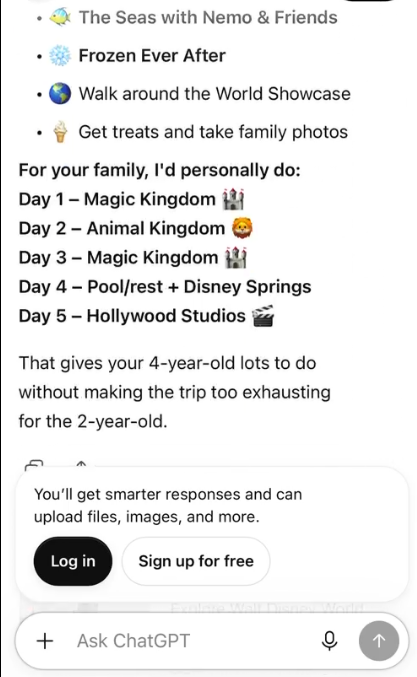
Travelers judged what they got against what they'd previously associated with a professional trip planner, and geographic clustering by day was the single most-praised feature.
Travelers weren't asking for a tour company. They were asking for an itinerary, and AI gave them one. Multi-day operators, packages and DMCs aren't out of the picture, they just come in later, once the plan exists. Inside the answer, an operator can still show up as a citation when the model builds the itinerary or backs up a claim in it.
What to do
- 1List the components of every itinerary in detail. Named guides, specific sites, permits, private access and what happens each day, in text the model can lift straight into the plan.
- 2If you don't supply real components, AI invents them or leaves you out. Publish what's real, and keep it current so the model has no reason to fill the gap.
Evaluate

What we saw
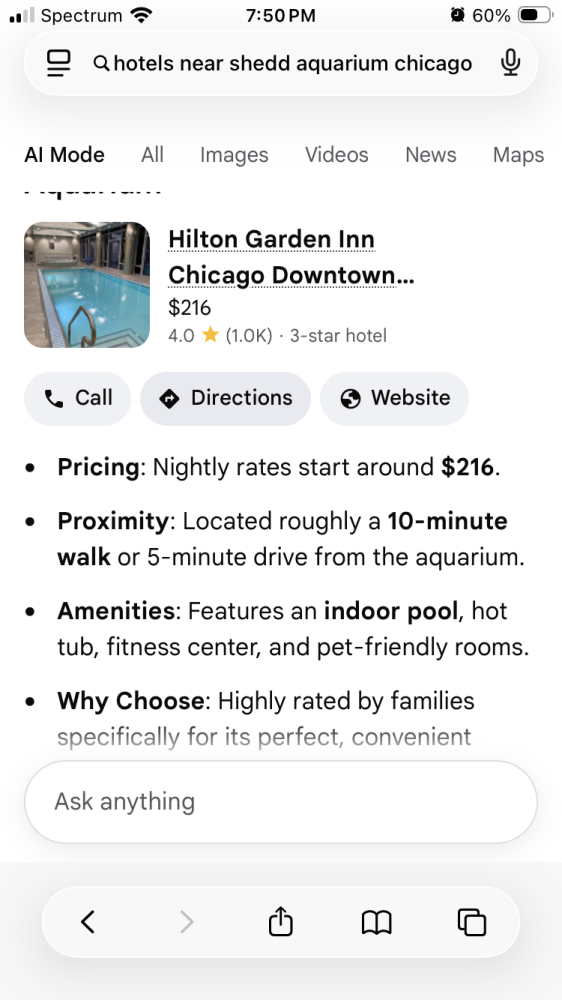
Reviews were the most-clicked element of a listing by a distance, photos second, and the most common complaint was a listing with too few of either. The complaint wasn't that the photos were bad. It was that there weren't enough of them.
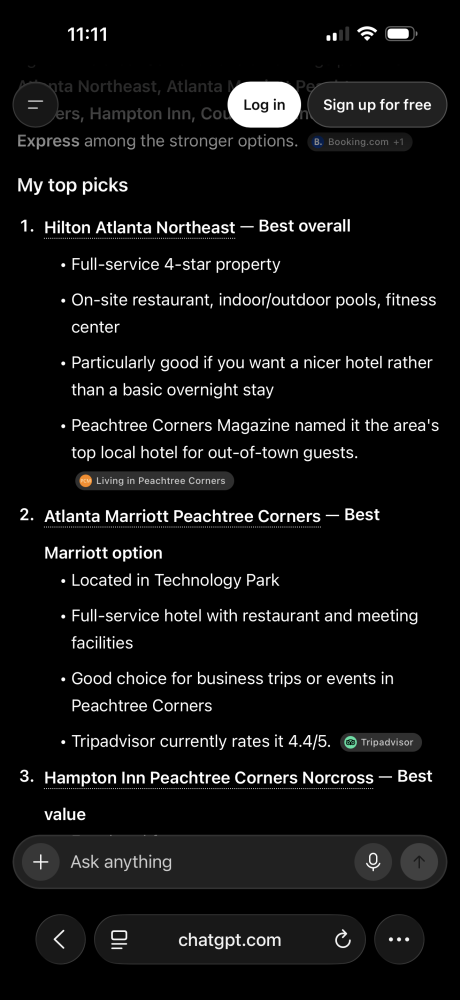
Self-written hotel descriptions carried almost no weight. Trust came from third-party reviews, photo volume including the surrounding area, and brand familiarity. Recognition bought a shortcut past independent verification, not the booking itself. Two assets a hotel doesn't write are carrying most of the trust.
Travelers and the models weren't reading the same thing. People went to the photos, the LLMs leaned on the reviews, and in Google AI Mode the photos came from the hotel's Google listing rather than its site. Travelers then went looking for both on outside sources before they'd trust them.
What to do
- 1Review operations is AI visibility work, not only reputation management. The models lean on reviews, and volume and recency are what they read.
- 2Photo depth is just as important as quality. Travelers wanted more photos, not better ones. In Google AI Mode those come from your Google listing.
- 3Travelers leave to verify on forums. Be in the discussion they check AI against, and keep your own pages current enough to pass the check.
- 4Publish current rates and seasonal offers on the page AI reads. Missing pricing was the most-named gap in the study.

Irrelevant ads backfire
And they backfire harder in AI than they do in search.
What we saw
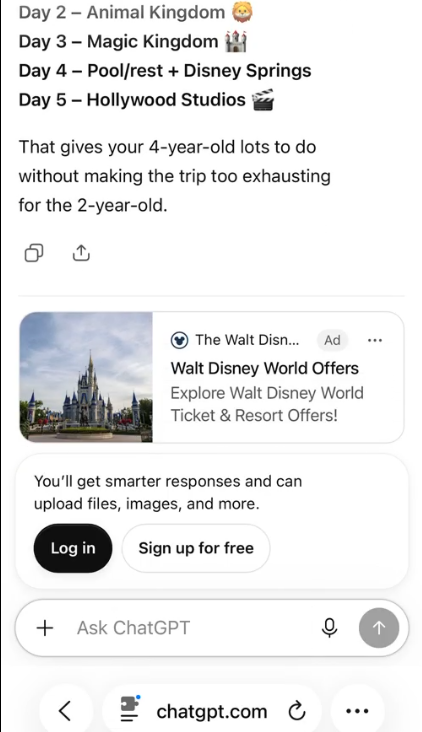
Ads didn't exist in these tools during the 2025 study. This is the first year we could watch travelers react to one. Most participants saw no sponsored content across the whole week, because ad inventory in AI answers is still thin. What matters is what happened among those who did.
The split tracked relevance, not disclosure. A discount on something a traveler had already shown interest in was welcomed and useful. A placement that read as unrelated to the question broke the sense that the answer was independent, the skepticism carried across the whole response, and some travelers went back and prompted again.
What to do
- 1Skip generic placement. It reads as an intrusion, and travelers treated the rest of the answer as an ad too.
- 2Put the offer in the answer, not beside it. The ads that got clicks carried a discount or matched the prompt closely.
- 3Keep advertising. This is a targeting finding: a miss simply costs more here than in search. Build each campaign to the whole prompt, with the group size, dates and budget travelers put in it.
Book

AI points travelers direct
AI is now a direct competitor to OTAs, and travelers are on AI's side.
What we saw
This is a big one. It's now two years in a row that we've seen the same finding: AI sends travelers to the operator, direct to the supplier. This year, 71% were told by AI to book direct. Last year, when the study covered Google AI Mode only, it was 80%. A consistent result, and now it holds across ChatGPT, Gemini and Google AI Mode, not just one tool.
One thing to hold alongside it: 68% of participants already preferred to book direct, so the AI may partly be reading a preference the traveler stated. We can't separate the two. What we know is that the result held two years running.
The AI's framing and traveler preference reinforce each other almost exactly. Participants who preferred direct cited no middleman, easier cancellations and refunds, and open suspicion that agencies push partner relationships ahead of traveler needs.
What to do, operators
- 1Claim and complete every surface AI reads, under one brand name. When your Google Business Profile doesn't match TripAdvisor or Viator, ChatGPT can show your rating with no link to your site.
- 2Make booking direct visibly better, with a rate or a perk AI can quote.
What to do, OTAs
- 1Shift investment from inventory breadth to quotable comparison content and ratings. The star rating in ChatGPT's carousel links back to the platform it came from.
- 2Expect to appear as a link rather than a brand, and build the landing page for a traveler who has already decided.

A recommendation standard, not a transaction standard
Travelers delegate the research and keep the payment.
What we saw
The booking handoff is close to broken. Trip details failed to arrive intact at the booking site in more than 75% of attempts, sometimes a partial carryover, usually dates only, sometimes nothing at all. Participants overwhelmingly blamed the hotel or the booking platform, not the AI. Nearly everyone re-entered information they'd already given the AI and still rated its recommendations 4.1 out of 5, and nobody said it would stop them using AI again. Our 2025 study found the same, with post-task trust above 4.3 out of 5 in AI Mode.
Many said they wouldn't want AI to complete a booking even if the handoff were flawless, because they want human control over confirmation and payment. Travelers already hand over research and shortlisting, which they wouldn't have done three years ago. What they hold back is the money.
What to do
- 1Build for agentic booking now. Google launched a version of agentic hotel bookings in the last week of September 2026, and major hotel groups are testing their own. The travelers who said they don't want AI to book for them were describing today's confidence. Fix the handoff before it moves.
- 2Publish rates, cancellation terms and room detail as text, not PDFs. Your website is what an agent reads to find and book you. Test the handoff from each major tool and record what survives.
Section 03
Methodology
A week-long diary study, run with Touchstone Research, fielded Aug 17 to Aug 24, 2026.
What participants did
This was a diary study rather than a lab session. Participants planned a real trip on their own devices, in their own time, using the AI tools they already use, and recorded themselves doing it. Five activities ran across the week, each built around a different travel audience.
Who took part
38 US travelers completed the diary, 21 women and 17 men. Ten were aged 18 to 27, ten 28 to 38, twelve 39 to 53, and six 54 or over, with a mix of ethnicity and region. Everyone had either booked a leisure trip in the previous six months or was actively planning one.
Why a diary and not a survey
A survey asks people to remember. This asked them to do something and recorded it while they did it. It also caught things nobody thought to ask about. No question in the diary asked whether travelers consider tour operators. We only know they didn't because we watched what they typed.

The state of AI visibility for travel in 2026
Eight findings, documenting the shift in travel search and discovery
The decision happens earlier than it used to, and it gets made by something reading for different signals than a search engine ever did.
With thanks to Touchstone Research, our partner in fielding this study.
